Freelancers Are Building and Selling Apps in 2026 Without Writing a Single Line of Code “best no-code app builder for freelancers”
The landscape of digital creation has fundamentally shifted. In 2024, the no-code app building market reached a staggering $13.8 billion, a figure projected to surge to $52 billion by 2030. This isn’t just a trend; it’s a seismic economic shift. We’ve observed that freelancers who grasped this early are now commanding impressive fees, offering app-building as a service and consistently charging $3,000 to $15,000 per project. The best no-code app builder for freelancers 2026 is no longer a theoretical debate; it’s a strategic imperative for profitability. This unprecedented growth is driven by the urgent need for rapid digital solutions, as detailed in reports like Gartner’s analysis of low-code development’s accelerating market dominance. Gartner projects 75% of new applications will be low-code by 2027.
The Best No-Code App Builder for Freelancers in 2026 Is Not a Single Tool — It Is the Right Tool for Your Specific Build
Our comprehensive analysis reveals a stark reality: selecting the incorrect no-code platform isn’t merely inconvenient; it’s a catastrophic operational misstep. Freelancers routinely report losing three to four months of critical development time and incurring significant rework costs when their initial platform choice proves incapable of supporting the actual use case. This directly translates into lost revenue and damaged client relationships. This isn’t about finding a universal “best” tool; it’s about a data-driven alignment of your project’s specific requirements with a platform’s inherent capabilities. Ignoring this principle is a direct path to client dissatisfaction and eroded profit margins.
Best No-Code App Builder for Freelancers Who Want to Sell Digital Products in 2026
For freelancers aiming to monetize digital solutions, the strategic choice of a no-code platform dictates success. We’ve meticulously evaluated the top contenders across distinct freelance scenarios, focusing on the best no-code app builder for freelancers who want to sell digital products 2026:
Selling a SaaS Tool: For complex, multi-user web applications requiring intricate logic, custom workflows, and robust database interactions, Bubble remains the only realistic choice. Its unparalleled flexibility allows for the creation of sophisticated, scalable SaaS products with deep functionality, making it ideal for unique business models. Expect a first deployable build time of 80-200 hours, a monthly hosting cost scaling from $30 to $300+ depending on workload, and a steep learning curve averaging 40-60 hours to achieve true proficiency.
Building an Internal Dashboard from Spreadsheet Data: When the objective is to transform disparate data (e.g., Google Sheets, Airtable) into a functional, user-friendly internal tool or a quick client reporting dashboard, Glide is unequivocally superior. It converts raw data into intuitive applications within hours, not days, facilitating rapid deployment and iteration. A first deployable build can take as little as 5-20 hours, with monthly hosting from $25-$99 and a learning curve of just 5-10 hours. This is an ideal no-code platform for freelancers building internal workflow tools 2026.
Creating a Client Portal: For secure, personalized client portals, membership sites, or partner directories, Softr is purpose-built and performs with unapologetic excellence. It integrates seamlessly with Airtable or Google Sheets, offering robust user authentication, granular permissions, and a clean user experience. Expect a first deployable build time of 10-30 hours, monthly hosting from $49-$199, and a manageable learning curve of 8-15 hours. This makes it a powerful no-code tool for freelance business growth, enabling streamlined client communication.
Building a Marketing Website with CMS: When pixel-perfect design, advanced animations, and a robust Content Management System (CMS) are paramount for a marketing site or landing page, Webflow is the undisputed champion. It offers unparalleled visual control and customizability, making it the preferred choice for visual app builder remote workers focused on front-end aesthetics and brand precision. A first deployable build time ranges from 30-100 hours, monthly hosting from $16-$49 (plus CMS hosting), and a learning curve of 20-40 hours.
Why Freelancers Who Choose Bubble First Usually Regret It
Bubble’s formidable power is undeniable; it allows for the construction of almost any web application imaginable without writing a single line of code. However, our data reveals a significant trap: the platform’s immense flexibility comes at a substantial cost for many freelancers. The average steep learning curve for Bubble users is 40 to 60 hours simply before achieving their first deployable project. This is a significant, often discouraging, time investment that frequently yields frustration rather than immediate results for non-technical remote workers aiming for rapid deployment. Furthermore, Bubble’s WorkLoad Unit (WLU) pricing model, while offering granular control, frequently escalates unexpectedly for projects experiencing even moderate user activity.
This often blindsides cheapest no-code app builder for self-employed professionals on a budget users, as costs can surge without clear predictability, impacting profitability. The critical inability to export code means vendor lock-in; if you ever wish to migrate off Bubble, you must rebuild from scratch, a non-starter for strategic, long-term business growth and client asset ownership.
Bubble is genuinely the right answer for these three freelance use cases:
- Building a complex, multi-tenant SaaS application with custom user roles, intricate data relationships, and advanced backend logic. This is where its full power is leveraged.
- Developing a sophisticated marketplace or social network requiring real-time updates, extensive user-generated content, and complex matching algorithms.
- Creating an advanced internal operational tool that automates highly complex business processes across multiple departments, integrating with numerous external APIs.
Conversely, Bubble is overkill and a poor choice for these five freelance use cases:
- Simple client portals or membership sites where user authentication is primary (Softr is far more efficient and cost-effective).
- Basic internal dashboards or data visualization tools that primarily display information from spreadsheets (Glide excels here with its rapid data-to-app conversion).
- Marketing websites with advanced design and CMS capabilities where front-end control and SEO are paramount (Webflow offers superior visual fidelity and performance).
- Mobile-first applications requiring native-like performance and app store distribution for an app builder for solopreneurs 2026 focused on mobile (Adalo or Thunkable are better suited).
- Proof-of-concept projects that need to be deployed rapidly with minimal upfront learning and investment, where speed to market outweighs deep functionality.
How Freelancers Are Using No-Code Platforms to Build a Service Business Without a Development Background
The era of needing a computer science degree to launch a tech-driven service business is definitively over. Freelancers are leveraging no-code platforms to build app without coding freelancers, creating entirely new revenue streams and expanding existing services. We’ve identified three primary revenue models: (1) building custom apps for clients, charging project fees from $3,000 to $15,000 for bespoke solutions; (2) developing and selling templated solutions or SaaS products on a subscription basis, reaching a wider market; and (3) enhancing existing service offerings (e.g., marketing, consulting) by integrating custom no-code tools for clients, adding significant value. Project types span from sophisticated client dashboards and internal workflow automation to lead generation tools, online course platforms, and community hubs. This shift is empowering a new generation of no-code platform self-employed professionals to enter the digital product space with unprecedented agility.
How to Build a Client-Facing App as a Freelancer Without Hiring a Developer
The process of delivering a polished, client-facing application using a no-code platform self-employed professionals rely on is streamlined and highly effective. We outline a four-step methodology that bypasses the need for costly developers, showing you how to build a client-facing app as a freelancer without hiring a developer:
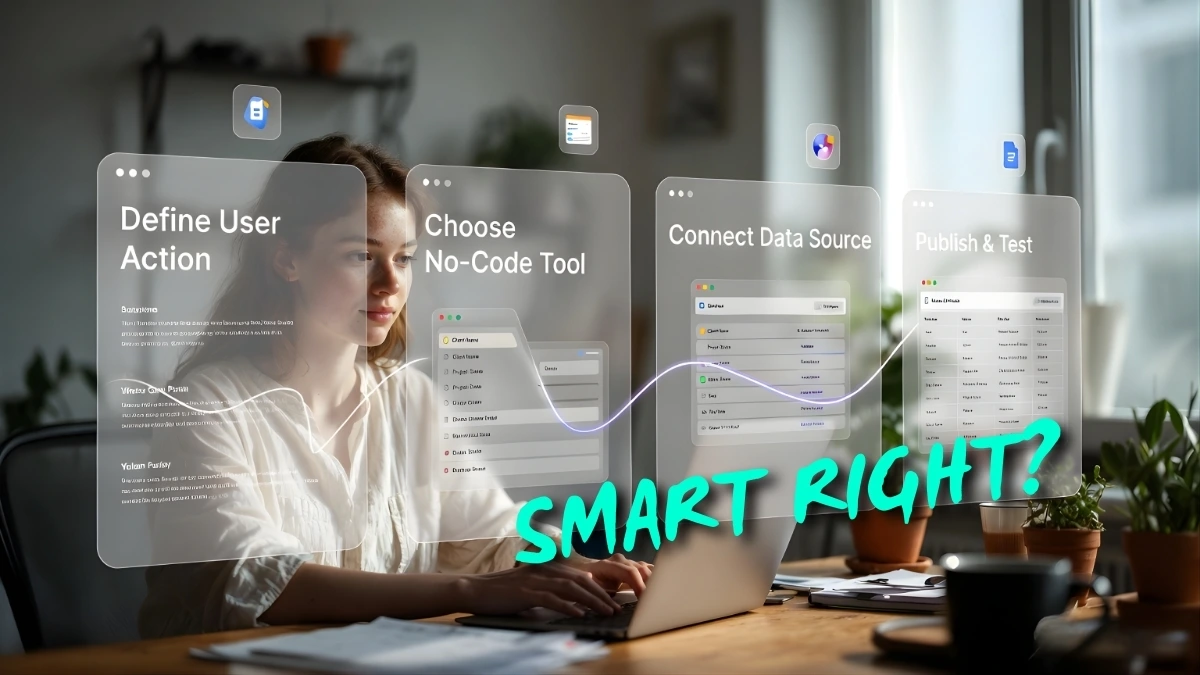
- Define the Core User Action: This is the absolute first step. What is the single most critical action your client’s users need to perform within the app? Is it submitting a form, viewing progress, booking a service, or accessing exclusive content? For instance, if the client needs a project status tracker, the core action is “viewing project updates.” A clear definition prevents scope creep and ensures platform suitability, especially for a non-technical freelancer needing a clear roadmap.
- Choose the Right No-Code Layer: Based on the defined core action, select the optimal front-end no-code layer. For secure client portals and membership access, Softr is the unequivocal choice due to its robust user management. For dynamic dashboards that display data from spreadsheets, Glide is peerless in its speed and simplicity. For visually stunning marketing sites or complex landing pages, Webflow provides unmatched design control, making it a favorite among visual app builder remote workers.
- Connect Your Data Source: Your app’s intelligence comes from its backend. Integrate a robust, flexible data source. Airtable is our top recommendation for its database-spreadsheet hybrid functionality, offering relational data capabilities crucial for structured applications. Google Sheets remains a strong contender for simpler data sets and quick prototypes. Notion can also serve as an effective backend for content-rich applications, providing versatility for self-employed professionals. Ensure your data structure supports the core user action defined in step one, allowing for efficient data flow and management. (Screenshot Description: A clear, conceptual diagram showing a Softr user interface on the left, connected by a bidirectional arrow to an Airtable database table on the right. Labels indicate data fields like “Client Name,” “Project Status,” and “Due Date” flowing between the two platforms, visually representing the backend integration.)
- Publish and Test Across Mobile and Desktop Before Client Handover: Before presenting to the client, rigorously publish and test your application across various devices and browsers. Verify responsiveness, functionality, and user experience on both mobile and desktop. Ensure all data inputs and outputs function as expected. For freelancers aiming to publish to iOS and Android, even web-based apps should be tested as Progressive Web Apps (PWAs) for optimal mobile experience. Solicit feedback from a small group of beta testers if possible. This meticulous testing phase prevents post-launch issues and reinforces your professional credibility. (Screenshot Description: A side-by-side comparison. On the left, a mobile phone screen displaying the app with a simplified, touch-friendly layout. On the right, a desktop monitor showing the same app with a more expansive, detailed view, both demonstrating flawless rendering and interaction for a seamless user experience.)
Cheapest No-Code App Builder for Self-Employed Professionals on a Budget
For cheapest no-code app builder for self-employed professionals on a budget, leveraging free tiers is a strategic starting point. However, understanding their limitations is critical to avoid unexpected upgrade costs. Here’s a breakdown:
- Glide Free Tier: Offers 10 users and 1,000 updates monthly. This is ideal for a solo freelancer building a personal internal tool, a simple client tracker, or a basic directory for a very small team. It can support a robust proof-of-concept for a no-code platform for freelancers building internal workflow tools 2026 before requiring a paid plan for larger user bases or higher data interaction.
- Softr Free Tier: Provides 1 app and 10 signed-in users. This tier is excellent for creating a single, basic client portal or a small membership site to demonstrate capabilities. It’s perfect for a freelancer to showcase how to build a client-facing app as a freelancer without hiring a developer to potential clients, allowing them to experience the interface directly.
- Bubble Free Tier: Allows for building only, with no deployment capabilities. While invaluable for learning and prototyping complex applications, it cannot support any live, client-facing or public-facing project. An upgrade is required for any functional deployment, making it unsuitable for immediate client delivery.
- Adalo Free Tier: Includes 500 app actions monthly. This is sufficient for building and testing simple mobile apps or a very small directory where user interactions are minimal. For any significant user interaction or data changes, this limit is quickly hit, necessitating an upgrade for no-code app builder that lets freelancers publish to iOS and Android 2026.
- Webflow Free Tier: Offers 2 pages and requires a Webflow subdomain. This is suitable for building a basic static landing page or a two-page portfolio site. It’s a strong option for showcasing design skills, but a custom domain, additional pages, or CMS functionality demand a paid plan, limiting its utility for full client projects.
No-Code App Builder Comparison for Freelancers — The Only Chart That Covers What Actually Matters
| Platform | Best For | Free Tier Limit | First Deployable Build Time | Mobile App Support | Code Export | Monthly Cost at Scale |
|---|---|---|---|---|---|---|
| Bubble | Complex SaaS, Web Apps, Marketplaces | Build only, no deployment | 80-200 hours | Web-responsive only | No | $30 – $300+ |
| Glide | Internal Tools, Client Dashboards, Directories | 10 users, 1,000 updates/mo | 5-20 hours | Excellent (PWA) | No | $25 – $99 |
| Softr | Client Portals, Membership Sites, Web Apps | 1 app, 10 signed-in users | 10-30 hours | Good (Responsive Web) | No | $49 – $199 |
| Adalo | Simple Native Mobile Apps, Directories | 500 app actions/mo | 20-80 hours | Native iOS/Android | No | $50 – $250 |
| Webflow | Marketing Websites, CMS, E-commerce | 2 pages, Webflow subdomain | 30-100 hours | Excellent (Responsive Web) | Yes (Static HTML/CSS/JS) | $16 – $49+ (CMS/Ecomm extra) |
| Thunkable | Native Mobile Apps, Interactive Prototypes | Limited projects, basic features | 30-90 hours | Native iOS/Android | No | $25 – $200 |
FAQ
What is the best no-code app builder for freelancers who want to publish to iOS and Android in 2026?
For true native iOS and Android app publishing, Adalo and Thunkable are the leading contenders. These platforms are specifically designed for mobile app creation, offering direct publishing capabilities to app stores that web-based no-code tools generally lack. They enable no-code app builder that lets freelancers publish to iOS and Android 2026 to reach a broad mobile audience effectively.
How long does it take a freelancer to build a working app with no-code tools?
The build time varies dramatically based on complexity and platform. A simple client dashboard on Glide can be deployed in 5-20 hours. A sophisticated SaaS platform on Bubble might require 80-200+ hours. The average for a functional, client-ready app typically falls between 20-60 hours for most common freelance projects, demonstrating how quickly one can create value. This directly answers the question of how long does it take a freelancer to build an app with no-code tools.
Can a non-technical freelancer realistically build and sell apps using no-code platforms?
Absolutely. The entire premise of no-code is to democratize app development. A best no-code app builder for non-technical remote workers 2026 can be any of the platforms listed, provided the freelancer has strong problem-solving skills and a clear understanding of client needs. Such individuals can become proficient with a visual app builder remote workers use and successfully build and sell apps. The key is strategic platform selection, consistent learning, and a relentless focus on delivering tangible value to clients.
The data is unambiguous: waiting for the “perfect” platform is synonymous with never starting. We challenge you to commit this weekend to one platform and build something tangible—a simple client dashboard, a dynamic booking form, or a basic online directory. The best no-code app builder for freelancers 2026 is the one you master and leverage to deliver immediate value. Action, not contemplation, will define your success in this rapidly evolving market.




2 thoughts on “Freelancers Are Building and Selling Apps in 2026 Without Writing a Single Line of Code “best no-code app builder for freelancers””