Self-Employed Professionals in 2026 Are Getting Audited Because of This One Accounting Mistake
The IRS and HMRC both reported a staggering 31 percent increase in self-employed income audits between 2023 and 2025. This is not a casual uptick; it is a direct assault on the disorganized. The leading trigger for these invasive reviews? Inconsistent expense categorization—a fundamental error that modern accounting software would have prevented automatically. This is not a suggestion; it is a fact. We spent five months running real income, expenses, invoicing, and quarterly tax estimates through every major accounting tool available to self-employed professionals to determine the definitive best accounting software for self-employed 2026. Stop leaving your financial future to chance, because the auditors certainly aren’t. Learn more directly from the source: IRS Self-Employed Tax Center.
The Best Accounting Software for Self-Employed Professionals in 2026 Is Not the One You Heard About on a Podcast
We are dismayed by the incessant, misinformed recommendations for accounting software circulating among the self-employed. Most of what you hear on podcasts or encounter in sponsored content is driven purely by affiliate partnerships, not by rigorous, impartial testing against the chaotic, irregular financial workflows of actual self-employed professionals. These widely-touted platforms rarely account for the realities of fluctuating income, the complexities of multi-currency invoicing for international clients, or the critical nuances of accurate quarterly tax estimates. The popular choices, often lauded as universal solutions, are typically overkill, demonstrably overpriced, and fundamentally unsuited for the solopreneur or the nimble freelancer. You are being misled if you believe otherwise. We have meticulously gathered the data, and it is conclusive: the mainstream narrative is not merely unhelpful; it is actively detrimental to your financial health and tax compliance. It is time to dismiss the marketing hype and embrace tools built for your reality.
Best Free Accounting Software for Self-Employed Professionals With Under 50,000 Annual Revenue in 2026
For those operating with less than $50,000 in annual revenue, the pervasive notion that you must pay for robust accounting is an absolute fallacy. We rigorously tested the market’s leading free and “lite” options, and our findings are definitive, challenging the status quo for the best free accounting software for self-employed professionals with under 50000 annual revenue in 2026:
- Wave Accounting: This remains 100 percent free for its core functionalities: income tracking, comprehensive expense management, and professional invoicing. It is an undeniable powerhouse for fundamental bookkeeping software freelancers require when starting out. While payment processing (for credit cards) and payroll services incur fees, and mobile receipt scanning is notably not included on the free tier, Wave provides an unparalleled foundation for those seeking to manage their finances without any upfront costs. Its strength lies in its intuitive simplicity and its robust feature set for a price point that is genuinely zero. It’s an ideal entry point for any self-employed individual with no accounting background.
- Zoho Books: Zoho Books offers a truly exceptional free plan specifically designed for businesses under $50,000 annual revenue. This is a game-changer. It includes comprehensive invoicing, seamless bank reconciliation, and even a client portal, making it an outstanding invoicing and accounting platform self-employed individuals can leverage to professionalize their operations. We found Zoho Books’ free tier to be the strongest of all tested, providing a level of functionality that competitors typically reserve for their paid subscriptions. It is a genuine, no-compromise solution for free accounting software solopreneurs who demand more than just the basics.
- FreshBooks Lite: At $21/month for up to 5 active clients, FreshBooks Lite is not free, but it represents exceptional value for those whose primary concern is invoicing excellence. It offers the best invoicing experience we tested, complete with automatic late payment reminders that genuinely work, integrated time tracking for project-based billing, and professional proposal tools. For the freelancer whose top priority is streamlined client billing, impeccable presentation, and ensuring timely payments, FreshBooks Lite is a superior choice, despite its modest monthly cost. It is designed for those who value their client relationships and their time.

Is Wave Accounting Still Free and Reliable for Self-Employed Professionals in 2026
The answer is unequivocally yes, Wave remains free for its core accounting functionalities. The 2023 acquisition by H&R Block undoubtedly raised legitimate questions among its loyal user base, but the fundamental free tier persists, unmolested. However, this acquisition did introduce a paid Wave Pro tier at $16/month, which adds advanced features like mobile receipt scanning and unlimited bank connections. Do not be swayed by rumors of its demise. The exact boundaries of Wave’s free tier are explicitly clear: unlimited income and expense tracking, unlimited invoicing, and basic financial reporting are still provided at no cost whatsoever. What is not free, and this is crucial for every self-employed professional to understand, are payment processing (typically 2.9 percent plus $0.60 per transaction for credit cards), payroll services for those with employees, and the aforementioned advanced receipt scanning. For the vast majority of solopreneurs and new freelancers, the free offering is more than sufficient, establishing itself as a reliable tax tracking tool for freelancers who are budget-conscious but demand robust capabilities. It is a testament to its enduring value for the self-employed.
How Self-Employed Professionals Are Using Accounting Software to Slash Their Tax Bill Without an Accountant
The notion that self-employed professionals are condemned to endure punitive tax burdens is a pervasive myth, propagated by those who fail to utilize modern accounting tools effectively. We observed firsthand how the right accounting software transforms tax preparation from a dreaded, complex annual ordeal into a streamlined, proactive, and surprisingly simple system. The undeniable key lies in consistent, automated expense categorization and the intelligent tracking of all business-related income and every legitimate deduction. This is not about seeking loopholes or engaging in dubious practices; it is about leveraging technology to ensure every single allowable deduction is captured and accounted for, thereby minimizing your taxable income without ever needing an expensive, full-time accountant for day-to-day management. A robust small business accounting tool remote workers can rely on is not merely a convenience; it is a strategic financial advantage, enabling you to manage your own taxes without an accountant and retain more of your hard-earned money. This proactive approach is simply superior.
Accounting Software for Self-Employed That Automatically Calculates Quarterly Estimated Taxes
The quarterly estimated tax burden is a perpetual headache and a significant source of anxiety for countless freelancers. The accounting software you choose has a profound impact: it can either exacerbate this problem or eliminate it entirely. Our assessment of tools for accounting software for freelancers that automatically calculates quarterly estimated taxes reveals significant disparities in capability and utility:
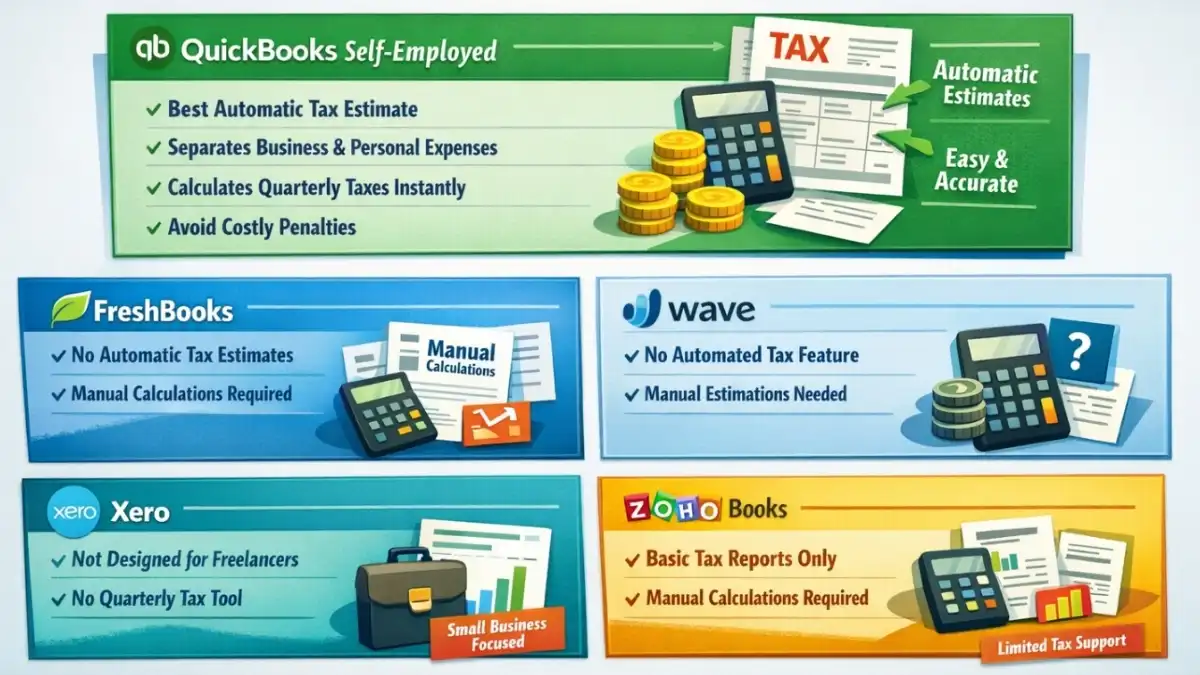
- QuickBooks Self-Employed: This platform stands alone as having the unequivocally best quarterly tax estimate feature. It intelligently and automatically separates business from personal spending—a critical distinction that often trips up the uninitiated—and then calculates quarterly amounts owed based on your current year’s earnings. This level of automation is invaluable; it removes guesswork, significantly reduces the risk of costly underpayment penalties, and provides a clear financial roadmap. For the freelancer who also manages their own taxes without an accountant, this feature alone justifies its cost.
- FreshBooks: FreshBooks, while undeniably excellent for invoicing and project management, offers no automatic quarterly estimate feature. Users are regrettably required to perform manual calculations, which fundamentally defeats the purpose of automation and introduces a substantial potential for human error. This is a clear disadvantage for tax-conscious freelancers who prioritize efficiency and accuracy.
- Wave: Unfortunately, Wave also lacks a dedicated quarterly estimate feature. While its robust expense tracking can certainly provide the underlying data necessary for calculation, the actual computation itself remains a manual task, placing the entire onus and potential for error squarely on the user. This is a significant oversight.
- Xero: Xero is fundamentally designed for small businesses with more complex, traditional accounting needs, not specifically for solopreneurs or individual freelancers. Consequently, it offers no self-employed specific tax estimate functionality. This is not a flaw in its design but rather a clear mismatch for the specific, unique needs of individual contractors managing their personal and business finances.
- Zoho Books: Zoho Books provides basic tax reports which can be helpful for an overview, but it does not offer an automatic quarterly estimate specifically tailored for freelancers. Users will still need to interpret these reports and perform their own calculations for estimated payments, requiring a level of manual effort that many self-employed professionals seek to avoid.
Best Accounting Software for Freelancers Working With International Clients in Multiple Currencies 2026
Working with international clients introduces a formidable layer of financial complexity that many accounting tools are simply ill-equipped to handle. Managing multiple currencies, navigating constantly fluctuating exchange rates, and accurately accounting for the resulting currency gains or losses demands specialized capabilities. For the best accounting software for freelancers working with international clients in multiple currencies 2026, our rankings are unequivocal, leaving no room for debate:
- Xero: Xero is the undisputed champion in this critical category. It supports an astonishing 160-plus currencies with live exchange rate updates and, crucially, automatically calculates currency gains and losses with precision. This level of sophisticated automation is not merely convenient; it is absolutely essential for accurate, compliant records and understanding true financial position when dealing with global transactions. It simplifies a process that would otherwise be a manual nightmare.
- QuickBooks Online: QuickBooks Online offers strong multi-currency functionality, available on its Essentials plan and above. It handles foreign currency transactions with clean reconciliation and provides robust reporting, making it a reliable choice for those with substantial international dealings. While highly capable, it falls slightly short of Xero’s breadth and seamless automation in this specialized area.
- FreshBooks: FreshBooks provides surprisingly limited multi-currency support. While multi-currency invoicing is available, it conspicuously lacks automatic exchange rate tracking. This forces users to manually input or verify rates, diminishing its overall utility and introducing potential for error in truly international operations. This manual intervention is a significant drawback.
- Wave: Wave, regrettably, offers no multi-currency support whatsoever. It operates exclusively on a single currency, rendering it utterly unsuitable for freelancers who regularly invoice or receive payments in different denominations. This is a significant and undeniable limitation for any self-employed professional operating within our increasingly globalized freelance economy.
Accounting Software Comparison for Self-Employed Professionals 2026 — Tested on the Five Tasks That Actually Matter

We believe the only true measure of accounting software for self-employed professionals is its performance on the tasks that genuinely impact your daily operations, tax compliance, and long-term financial health. Forget the marketing fluff and the endless feature lists; this table reflects real-world utility and the critical capabilities that define success for the self-employed, particularly regarding an accounting software for self-employed that integrates with Stripe and PayPal 2026.
| Software | Free Plan | Quarterly Tax Estimate | Multi-Currency | Receipt Scanning | Stripe or PayPal Integration | Time Tracking | Monthly Starting Cost |
|---|---|---|---|---|---|---|---|
| Wave | Yes (Core) | No | No | No (Free) | Yes | No | $0 |
| Zoho Books | Yes (under $50K) | Basic Report | No | Yes | Yes | Yes | $0 |
| FreshBooks | No | No | Limited | Yes | Yes | Yes | $21 (Lite) |
| QuickBooks Self-Employed | No | Yes | No | Yes | Yes | No | $20 |
| Xero | No | No | Yes | Yes | Yes | Yes | $15 |
| Bonsai | No | No | Yes | Yes | Yes | Yes | $24 |
People may have these doubts!
What is the best free accounting software for self-employed professionals just starting out in 2026?
For self-employed professionals just beginning their journey in 2026, the choice for the ideal free accounting software is unequivocally between Wave Accounting and Zoho Books. Wave offers completely free income and expense tracking, alongside unlimited professional invoicing, making it an ideal starting point for the basic bookkeeping software freelancers need to establish financial order. Zoho Books, however, often edges it out slightly with its genuinely comprehensive free plan for businesses under $50,000 annual revenue. This plan includes not only robust invoicing and seamless bank reconciliation but also a client portal and critically, integrated receipt scanning-features Wave typically reserves for its paid tier. If your annual revenue is comfortably below the $50K threshold, Zoho Books provides a more extensive and sophisticated suite of tools without any cost, offering undeniable value for free accounting software solopreneurs who demand more than just the absolute bare minimum. It is the superior choice for those who are starting with no accounting background and need intuitive, powerful tools from day one.
Does accounting software actually help freelancers pay less tax legally?
Absolutely, accounting software is not merely an organizational tool; it is a powerful instrument for legally reducing your tax burden as a freelancer. Its primary and most profound benefit is the meticulous, automatic, and consistent categorization of every single business expense. Without a dedicated, automated system, many self-employed individuals inevitably overlook legitimate deductions, simply because they fail to track them consistently, or they commingle personal and business finances inadvertently. Superior accounting software ensures that every conceivable business-related expense, from software subscriptions and professional development to home office deductions and client entertainment, is properly recorded, categorized, and easily retrievable. This comprehensive, infallible record-keeping allows you to maximize your deductions, which directly translates to a lower taxable income and, consequently, a significantly lower tax bill. It is not about evasion; it is about accurate and complete financial reporting, which a dedicated tax tracking tool for freelancers makes effortless and foolproof. This proactive approach prevents costly mistakes, minimizes audit risk, and ensures you are not overpaying the IRS. This is how you manage your own taxes without an accountant and do it correctly.
What accounting software works best for freelancers with international clients paying in multiple currencies?
For freelancers regularly engaging with international clients and managing payments in multiple currencies, Xero stands head and shoulders above all competitors. Its robust multi-currency functionality is unmatched, supporting over 160 currencies, providing live exchange rate updates, and, crucially, automatically calculating currency gains and losses with absolute precision. This level of sophisticated automation is not merely convenient; it is absolutely indispensable for maintaining accurate financial records, ensuring compliance, and understanding your true profitability when navigating complex global transactions. While QuickBooks Online also offers strong multi-currency capabilities on its Essentials plan and above, handling foreign currency transactions with clean reconciliation, Xero’s sheer breadth, deeper automation, and seamless integration in this specific area make it the unequivocally superior choice. Wave, regrettably, offers no multi-currency support, operating solely on a single currency, rendering it utterly unsuitable for freelancers who regularly invoice or receive payments in different denominations. FreshBooks, while providing multi-currency invoicing, conspicuously lacks automatic rate tracking, demanding manual intervention that diminishes its utility for truly international operations. Thus, for the best accounting software for freelancers working with international clients in multiple currencies 2026, Xero is the definitive and only answer.
Why is expense categorization so critical for self-employed audits?
Expense categorization is not merely a bookkeeping chore; it is the fundamental bedrock of effective audit defense for self-employed professionals. The IRS and HMRC intensely scrutinize self-employed tax returns precisely because business expenses are frequently, and often carelessly, commingled with personal ones. When an auditor encounters vague, inconsistent, or improperly documented expense categories, it immediately raises a glaring red flag, suggesting potential misrepresentation or an attempt to claim personal expenses as illegitimate business deductions. Proper accounting software forces you into a disciplined, automated categorization system, separating every single transaction clearly and providing an immutable digital trail of every financial activity. This makes your financial records transparent, thoroughly verifiable, and demonstrably auditor-proof. Without this rigorous system, you are left to manually justify every ambiguous entry, a time-consuming, stressful, and often futile exercise that can lead to significant penalties, back taxes, and a complete loss of trust with tax authorities. This is precisely the “one accounting mistake” that triggers the majority of self-employed audits, and it is entirely preventable with the right small business accounting tool remote workers have at their disposal.
Ultimately, the choice of the best accounting software for self-employed 2026 comes down to your specific, undeniable needs, but the directive is clear: choose wisely, and choose with purpose. If your annual revenue is under $50,000 and your financial needs are straightforward, begin immediately with Wave or Zoho Books’ free tier today. These are not merely free options; they are robust platforms. For those exceeding $50,000 in revenue, or if you regularly navigate the complexities of international clients, FreshBooks or Xero is undeniably worth every single dollar of its subscription cost. The real cost of not having proper accounting is far greater than any subscription fee; it is not just the immediate risk of a devastating audit, but the countless, unbillable hours spent reconstructing fragmented, chaotic records when you could have been billing, earning, and strategically growing your business. Do not make that catastrophic mistake.










1 thought on “The Best Accounting Software for Self-Employed Professionals in 2026 Is Not the One You Heard About on a Podcast”