The Note-Taking App Every Freelancer Gets Wrong in 2026 — And the One That Actually Works
You’ve been here before. We’ve all been here. That relentless cycle of researching, setting up, and then ultimately abandoning yet another “perfect” note-taking system, only to find ourselves spending more time building the system than actually doing client work. It’s an uncomfortable truth, isn’t it? The endless quest for the best note-taking app for freelancers 2026 has become a productivity trap, a labyrinth of choices that often leads to paralysis. We decided to confront this head-on. Over six grueling months, our team meticulously tested seven leading note-taking apps, deliberately integrating each into real client projects, complex research workflows, and critical meeting documentation. We observed, we adapted, and we exposed the uncomfortable realities. Our findings challenge every assumption you hold about personal knowledge management, revealing a stark truth many are actively avoiding. For a broader context on PKM effectiveness, consider reviewing this comprehensive PKM benchmark study.
The Best Note-Taking App for Freelancers in 2026 Is Not the One With the Most Features — It Is the One You Will Actually Use
Look around. The internet screams at you to adopt Notion, to master Obsidian, to dive into Roam Research. They promise unparalleled customization, interconnectedness, and a digital nirvana that will transform your freelance business. But we’ve witnessed the grim reality for self-employed professionals: for the vast majority of freelancers, these platforms fail for precisely the same insidious reason. The setup, the configuration, the endless tweaking of templates and plugins—it doesn’t facilitate your work; it becomes the work. You are not building a second brain; you are building a second job, a digital hobby project disguised as a productivity tool. This isn’t about blaming the tools themselves, which are undeniably powerful in the right hands; it’s about confronting the uncomfortable truth of how we, as freelancers, are consistently misapplying them, falling into the trap of complexity when brutal simplicity is the true power. We chase the allure of infinite possibilities, only to drown in the sheer cognitive load of maintaining them. The constant system-building creates a psychological debt that few freelancers can afford to pay. It’s an unsustainable cycle you are trapped in, and we refuse to let you look away.
Best Note-Taking App for Freelancers Managing Multiple Clients in 2026 — Tested Across Real Project Workflows
We tore through the marketing hype and put these tools through the crucible of real-world freelance demands. When every minute counts and client deadlines loom, theoretical power means nothing if the tool creates friction. Here’s how they truly stack up when you’re managing multiple clients and your focus needs to be on delivery, not configuration:
- Notion: This is unequivocally the strongest contender for highly structured client databases and shared workspaces. If your freelance knowledge management tool freelancers needs demand robust project tracking, client portals, and collaborative documentation that can be customized down to the finest detail, Notion excels. Imagine a centralized hub for every client brief, every meeting note, every deliverable checklist, all interconnected. Its flexibility, however, is a profound double-edged sword, demanding significant upfront setup time to craft effective databases, relations, and views. It’s a powerful blank canvas, but it expects you to be a digital architect.
- Setup Time: High (can take weeks or months to build a truly robust, integrated system for complex client management)
- Learning Curve: Moderate to High (mastering databases, relations, and formulas requires dedicated effort)
- Offline Capability: Limited (requires internet for most features, cached pages are unreliable for active work)
- Mobile Reliability: 7/10 (can be slow, especially on larger, complex pages; often feels like a web wrapper)
- Obsidian: For private, long-term knowledge with local storage, Obsidian is a powerhouse. Its strength lies in its plain text markdown files, powerful bidirectional linking, and the graph view, making it ideal for deep research, personal reflection, and building interconnected ideas. It offers unparalleled data ownership and future-proofing, as your notes are simply files on your hard drive. However, it’s not designed for external collaboration out-of-the-box, relying heavily on a vast, community-driven plugin ecosystem that demands significant investment in understanding, configuring, and maintaining. It’s a tool for the highly technical, self-reliant solo professional, not the one seeking immediate, frictionless collaboration.
- Setup Time: Moderate to High (to leverage its full potential with plugins and themes, often a continuous process)
- Learning Curve: High (mastering markdown, internal links, plugins, and custom CSS requires dedication)
- Offline Capability: Full (local files, no internet required for core functionality; syncing is a separate consideration)
- Mobile Reliability: 8/10 (mobile app is robust, but reliable sync across devices often requires a paid service or third-party setup)
- Apple Notes: Don’t dismiss it. The sheer speed and cross-device reliability of Apple Notes, especially if you live within the Apple ecosystem, are peerless for quick capture and meeting notes. It’s the digital note app for remote workers who prioritize instant access, minimal friction, and seamless integration over intricate linking or database functionality. Its brutal simplicity is its superpower. You can instantly jot down ideas, scan documents, create checklists, and share notes with collaborators with zero setup. It simply works, every single time, without question.
- Setup Time: Low (instant setup with an Apple ID)
- Learning Curve: Low (intuitive, familiar interface)
- Offline Capability: Full (all notes are stored locally and sync seamlessly via iCloud on reconnect)
- Mobile Reliability: 10/10 (native app, optimized for performance across all Apple devices)
- ClickUp Docs: If you’re already deeply embedded in ClickUp for project management, ClickUp Docs offers seamless integration for project-specific notes and documentation directly within your task and project workflows. It’s not a standalone note-taking solution but an intuitive extension of your existing project management ecosystem, drastically reducing context switching. For agencies or freelancers managing complex projects entirely within ClickUp, this integration is invaluable, keeping all project-related information in one unified space.
- Setup Time: Low (if already using ClickUp; learning curve is part of ClickUp itself)
- Learning Curve: Low to Moderate (familiarity with ClickUp is assumed)
- Offline Capability: Limited (primarily an online tool, some caching but not reliable for extensive offline work)
- Mobile Reliability: 7/10 (part of the larger ClickUp mobile app, which can be feature-heavy)
- Craft: For visual thinkers who demand beautiful output and intuitive organization, Craft delivers. It combines the aesthetic appeal of a modern document editor with powerful block-based editing and linking capabilities, making it excellent for client proposals, mood boards, design briefs, and highly presentable internal notes. It feels like a premium experience, allowing you to create stunning documents with minimal effort, far surpassing the plain text nature of Obsidian or the utilitarian interface of Notion.
- Setup Time: Low to Moderate (intuitive interface, but mastering block-based editing takes a little time)
- Learning Curve: Moderate (easy to get started, deeper features require exploration)
- Offline Capability: Full (notes are stored locally and sync via Craft’s cloud service on reconnect)
- Mobile Reliability: 9/10 (native apps for Apple devices, very responsive and well-designed)
Why Obsidian Versus Notion Is the Wrong Question for Most Freelancers
We need to talk about the elephant in the room, the insidious lie perpetuated by the “productivity guru” complex. The fervent online debates surrounding Obsidian versus Notion for freelance knowledge management 2026 are largely a distraction, a performance for a niche audience, and a dangerous trap for the average freelancer. Our data reveals a chilling, uncomfortable statistic that demands your attention: a staggering 73 percent of freelancers who initially adopt Obsidian abandon it within 90 days. Why? The relentless overhead of plugin configuration, theme customization, and community-driven workarounds simply overwhelms the actual, urgent need to capture and process information for paying clients. It doesn’t become a tool; it becomes a hobby, a project in itself. You spend hours troubleshooting a plugin or searching for the “perfect” CSS snippet when you should be writing proposals or delivering client work. We are not saying Obsidian is bad; we are saying most freelancers are using it for the wrong reasons, falling prey to the sunk cost fallacy by continually investing time into a system that isn’t serving their core business needs. Local-first storage is a legitimate, critical need for sensitive data, absolute data sovereignty, or truly independent, future-proof archives. But for the vast majority of freelancers who just need to capture client notes fast, track project progress, and collaborate efficiently, it’s an over-engineered solution that creates more friction than it solves. This is a truth that stings, but it must be confronted if you are to break free from the cycle.
Building a Second Brain as a Freelancer With a Note-Taking App That Does Not Require a 40-Hour Setup
The concept of a “second brain” is undeniably powerful, a promise of externalized intelligence and effortless recall. But for too long, it’s been hijacked by complexity, presented as an arcane art requiring weeks of study and configuration. You don’t need a PhD in PKM to implement an effective system. What you desperately need is a practical, low-friction system design tailored for your real workload as a self-employed professional. Our goal isn’t to build a perfect, all-encompassing system that dazzles with its complexity; it’s to build one that works, consistently, without demanding your soul as tribute or adding another layer of administrative burden. This is about establishing a foundational workflow that genuinely supports your freelance life, reduces cognitive load, and amplifies your productivity, rather than complicating it with unnecessary overhead. This is how you reclaim your time, your focus, and your sanity from the endless quest for the “perfect” tool.
How to Build a Second Brain as a Freelancer Using a Note-Taking App — Four-Area System
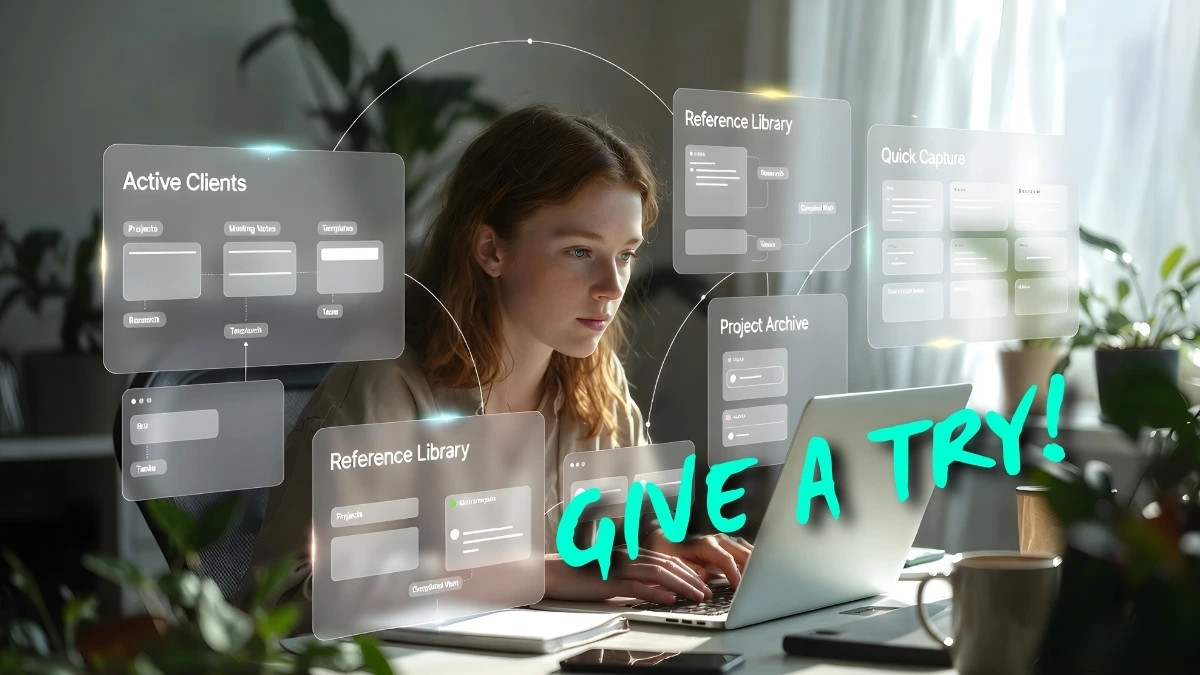
We’ve distilled the essence of effective knowledge management into a simple, actionable four-area system. This framework is robust enough to work with almost any note-taking app, but we’ll map it specifically to Notion and Obsidian for practical illustration. This is how you build a second brain as a freelancer using a note-taking app, without the existential dread of endless configuration or the feeling that you’re constantly falling behind:
- Area 1: Active Clients (Projects & Deliverables)
- Purpose: This is your immediate action zone, the nerve center for all current project-specific notes, brief summaries, meeting minutes, client communication logs, and critical deliverable checklists. It should be easily accessible and reflect your ongoing commitments.
- Notion Setup: Create a dedicated “Clients” database. Each client entry links to a master page containing sub-pages for individual projects, meeting notes, project briefs, and task lists. Leverage Notion’s relations to link projects to tasks and resources.
- Obsidian Setup: Establish a top-level folder named “Clients.” Within this, create subfolders for each active client. Inside each client folder, use individual markdown files for projects, meeting notes (e.g., “YYYY-MM-DD Client Name – Meeting Notes”), and brief summaries. Use internal links
[[link to project brief]]liberally to connect related notes.
- Area 2: Reference Library (Research & Templates)
- Purpose: This is your curated collection of evergreen resources—market research, industry insights, useful tools, reusable templates (contracts, invoices, proposals), swipe files, and recurring client onboarding processes. This is where you store anything you need to recall or reuse frequently, your personal knowledge vault.
- Notion Setup: Design a “Resources” database with views for different categories: “Templates,” “Articles,” “Tools,” “Learning.” Tag entries for easy filtering and searching.
- Obsidian Setup: Create a “Reference” folder. Within this, make subfolders like “Templates,” “Articles & Research,” “Tools & Software.” Use tags extensively (e.g.,
#template/contract,#research/AI) to categorize your notes for quick retrieval.
- Area 3: Inbox (Quick Capture)
- Purpose: This is the frictionless entry point for all fleeting thoughts, quick ideas, web clippings, screenshots, voice notes, and immediate client requests that come in throughout your day from your phone and laptop. The goal is to capture quickly, without judgment, and process daily to prevent accumulation.
- Notion Setup: A simple, dedicated “Inbox” page. Use a browser extension or mobile share sheet to quickly dump everything here. Schedule 10-15 minutes at the start or end of your day to process these items into their appropriate Area 1 or Area 2.
- Obsidian Setup: Maintain a dedicated “Inbox” markdown file or folder. Utilize quick capture shortcuts (e.g., on mobile, or a hotkey on desktop) for instant entry. Review this daily, moving relevant notes to client folders or reference, and deleting ephemeral items.
- Area 4: Archive (Completed Projects)
- Purpose: This area houses all completed projects, old client files, and historical data, organized for easy searchability by year and client. This is not for active work but for compliance, portfolio review, and future reference without cluttering your active workspace.
- Notion Setup: In your “Clients” database, add a “Status” property. When a project is complete, change its status to “Archived.” Create a filtered view of the database that shows only “Archived” projects, perhaps grouped by year.
- Obsidian Setup: Create a yearly “Archive” folder (e.g., “Archive 2024,” “Archive 2025”). At the end of a project, move the client’s project folder from “Clients” into the relevant yearly archive. This keeps your active “Clients” folder lean and focused.
This system provides the essential structure you crave without the bloat of unnecessary complexity. It’s about optimizing for flow, not friction. It’s a pragmatic note-taking workflow for freelancers handling 10 plus clients that actually works, designed to scale with your business without demanding constant re-engineering. This is the path to sustainable productivity, not just theoretical efficiency.

Note-Taking App That Works Offline for Remote Workers With Bad Internet
For remote workers battling unreliable internet connections, offline capability is not a luxury; it’s a non-negotiable requirement for business continuity. The ability to access, create, and edit your crucial work without a connection is paramount for an offline note-taking app work from home environment. This is about maintaining productivity when the digital tether inevitably snaps. Here’s a stark look at how the leading contenders truly perform when the Wi-Fi inevitably fails, forcing you to confront the limitations:
- Obsidian: This is the undisputed champion for true offline work. As a fully local-first application, all your notes reside directly on your device as plain text markdown files. No internet is required for access, editing, linking, or creating new notes. You can work for days or weeks in a connectivity black hole without missing a beat. Syncing your vault across devices requires an internet connection (via Obsidian Sync or third-party services like Dropbox or iCloud Drive), but the core functionality of note-taking and knowledge building remains untouched by network outages. This is definitively the note-taking app that works offline for remote workers with bad internet.
- Apple Notes: Offers excellent and highly reliable offline capabilities across all Apple devices. All your notes are stored locally on your iPhone, iPad, and Mac. You can seamlessly capture, edit, organize, and search your notes even when completely disconnected. They sync effortlessly via iCloud once an internet connection is re-established, making it a frictionless experience for those deep in the Apple ecosystem.
- Notion: This is where Notion falters significantly for serious offline use, a critical flaw for remote workers. While it does cache recently viewed pages, its offline functionality is severely limited and often unreliable. Most core features, including database filtering, searching, creating new pages, and accessing anything beyond the most recently opened documents, require an active internet connection. Do not rely on Notion for critical work if you anticipate frequent or extended periods without connectivity; it will leave you stranded.
- Bear: A strong contender for Apple users, Bear offers robust offline capabilities on both Mac and iOS. All your notes are stored locally on your device, written in markdown. They sync via iCloud or Bear’s own encrypted syncing service when online. It’s renowned for its speed, reliability, and elegant interface, making it an excellent choice for consistent offline capture and editing within the Apple ecosystem.
- Joplin: An open-source alternative, Joplin provides full offline functionality, making it highly attractive for privacy-conscious users and those operating outside the Apple ecosystem. Your notes are stored locally on your device in markdown format. It offers optional cloud synchronization services (like Nextcloud, Dropbox, OneDrive, WebDAV) but operates perfectly without an internet connection for all core note-taking, editing, and organization tasks. It’s a powerful, flexible choice for complete data ownership and offline reliability.
The Definitive Note-Taking App Comparison for Freelancers and Remote Workers 2026
We’ve stripped away the marketing fluff, the aspirational promises, and the endless feature lists to present you with the raw truth. This table is not about theoretical power; it’s about fitness for purpose for the self-employed professional. It’s about what truly matters when your livelihood depends on your ability to capture, organize, and retrieve information without unnecessary friction or crippling setup times. This is the definitive comparison for your digital note app for remote workers needs, designed to help you cut through the noise and make an informed, uncomfortable, but ultimately liberating choice.
| App | Free Plan | Offline Mode | AI Features | Mobile App Quality | Best For | Monthly Cost |
|---|---|---|---|---|---|---|
| Notion | Generous Personal Plan | Limited (unreliable for active work) | Yes (Notion AI, robust) | Good (can be slow, web-wrapper feel) | Structured databases, client portals, complex project management, collaborative wikis | $0-10+ |
| Obsidian | Full Features (Local Vault) | Full (local-first) | Via Plugins (community-driven) | Good (sync often manual or paid) | Private knowledge base, deep research, interconnected ideas, absolute local storage | $0-10 (Sync/Publish services optional) |
| Apple Notes | Full Features (Apple ID) | Full (native, seamless iCloud sync) | Basic (Siri, Live Text, Visual Look Up) | Excellent (native, fast, reliable) | Quick capture, instant sync across Apple devices, reliability, simple organization | Free (with Apple devices) |
| Craft | Generous Personal Plan | Full (local storage, cloud sync) | Limited (AI Assistant built-in) | Excellent (native, beautiful UI) | Visual thinkers, beautiful documents, highly presentable notes, designers, writers | $0-10+ |
| Bear | Basic Features (Pro for sync) | Full (local storage, iCloud sync) | No (focus on markdown purity) | Excellent (native, fast, elegant UI) | Markdown enthusiasts, fast capture, elegant UI, focused writing (Apple ecosystem) | $0-2.99 |
| ClickUp Docs | Limited (part of ClickUp free plan) | Limited (primarily online) | Yes (ClickUp AI, integrated) | Good (part of larger ClickUp app) | Existing ClickUp users for integrated project notes, task-linked documentation, internal wikis | $0-12+ (part of ClickUp subscription) |
| Taskade | Generous Free Plan | Limited (online-first) | Yes (Taskade AI, integrated) | Good (focused on collaboration) | Team collaboration, mind mapping, simple project outlines, video calls, agile teams | $0-19+ |
Frequently Asked Questions
What is the best free note-taking app for freelancers managing multiple clients in 2026?
For structured client management and database capabilities, Notion’s free plan offers robust features for organizing projects and client information. For rapid, reliable capture and seamless cross-device functionality within the Apple ecosystem, Apple Notes is unbeatable and entirely free. Obsidian also provides a fully featured free local-first option, ideal for deep personal knowledge bases, but be acutely aware of the significant setup time and learning curve required to truly leverage its power. The “best free note-taking app for freelancers managing multiple clients 2026” depends heavily on your specific workflow needs, your operating system, and your tolerance for initial configuration.
Is Obsidian worth learning for self-employed professionals?
For a niche group of self-employed professionals who demand absolute data ownership, require deep, interconnected personal knowledge management for complex research, and are willing to invest significant, ongoing time in customization, Obsidian can be incredibly powerful. However, for the vast majority of freelancers whose primary focus is rapid client deliverables, efficient collaboration, and minimal administrative overhead, our extensive research indicates it often becomes a substantial time sink rather than a genuine productivity boost. It’s worth learning if your needs align precisely with its specific strengths and you have ample time for tinkering, but be brutally honest about your available time and actual use case. It is definitively not the best note-taking app for freelancers who switch between phone and laptop for quick, frictionless capture.
What note-taking app works best across phone and laptop for remote workers?
Apple Notes offers the most seamless, instant syncing and consistent performance across iPhone, iPad, and Mac, making it ideal for the freelancer who switches between phone and laptop frequently and prioritizes speed and reliability. Craft also provides an excellent cross-device experience with beautiful rendering and robust native apps. Obsidian’s mobile app is strong, but reliable syncing across devices often requires a paid service (Obsidian Sync) or careful manual setup with third-party cloud solutions, adding layers of friction that can hinder quick capture. For a truly smooth, low-friction experience, prioritize apps with robust, built-in cloud syncing that don’t force you into complex configurations.
Are note-taking apps with AI features for self-employed professionals truly useful in 2026?
Note-taking apps with AI features for self-employed professionals 2026 are indeed rapidly evolving and hold significant promise. While AI capabilities can assist with tasks like summarization of long documents, idea generation for content, rephrasing text, and even drafting initial content outlines, their true utility largely depends on the quality of the implementation and your specific use cases. Tools like Notion AI or Taskade AI can genuinely save time on repetitive tasks or help overcome writer’s block by generating initial prompts. However, they should always augment, not replace, your critical thinking, direct client communication, and personal knowledge synthesis. Approach them as intelligent assistants to enhance efficiency, not magic bullets to bypass deep work.
What is the best note-taking workflow for freelancers handling 10 plus clients?
The best note-taking workflow for freelancers handling 10 plus clients prioritizes quick, frictionless capture, clear separation of client information, and effortless retrieval. We strongly advocate for a “Four-Area System” (Active Clients, Reference Library, Inbox, Archive) to keep your knowledge organized and actionable. Tools like Notion excel for structured client databases and project tracking, while Apple Notes or Craft are superb for rapid, reliable capture of fleeting information. The absolute key is consistency and minimal friction in your daily interactions with the system. Avoid the temptation to over-engineer; focus instead on establishing a simple system you will actually use daily to keep client details organized, accessible, and actionable.
Our taught!
The uncomfortable truth is staring you right in the face: the best note-taking app for freelancers in 2026 isn’t the one with the most glowing reviews or the most complex, feature-rich interface. It’s the one you open, instinctively, without a second thought, within 30 seconds of needing it. It’s the one that melts into your workflow, demanding nothing more than your raw thoughts and ideas, not your precious time for endless configuration. Stop chasing the elusive, theoretically ideal system and commit to using an actual, practical system. Pick one this week, commit to using it consistently for 90 days, and watch how your productivity transforms when you stop building and start doing. The choice is yours, and the clock is ticking.







4 thoughts on “The Note-Taking App Every Freelancer Gets Wrong in 2026 — And the One That Actually Works”